Tips for generating and screening ideas from Facebook, IDEO, Google, and others
The below is the first chapter of a paper I’m writing as part of my Managing Innovation class at Harvard Business School. The paper is a collection of Product Management best practices from tech companies such as Amazon, Google, IDEO, and Microsoft. It also brings in best practices from non-tech companies such as McKinsey and Target that I thought would be useful. This first chapter is specifically on idea generation and screening.
Huge thanks to my classmates Abhinav Agrawal (@agrawal667), Stephanie Christofides (@schristofides), Amit Garg (LI), Kishan Madamala (@kishan7), Minal Mehta (@mili2), and Arjun Ohri (LI) who made this paper possible. Thanks  for putting up with my interviews!
What do I mean by idea generation and screening?
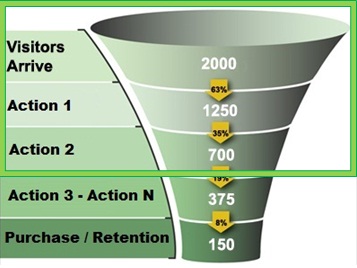
Our first year curriculum introduces the funnel as a metaphor to think about an organization’s innovation system (like any business school, we’re big fans of funnels and 2×2’s):
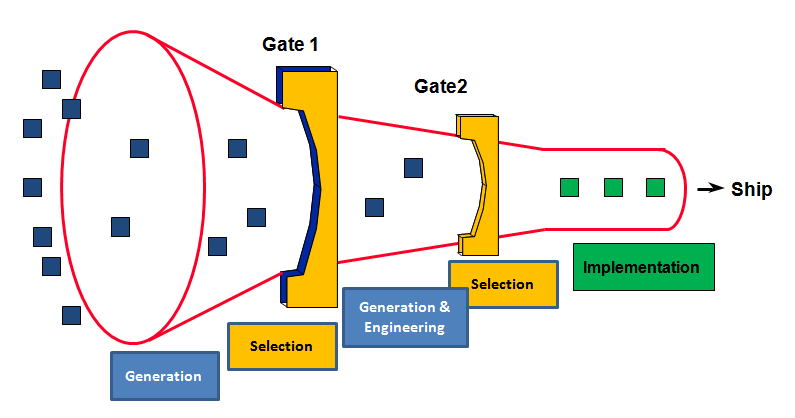
(Illustration from Professor Roy Shapiro’s TOM wrap-up slides)
In any organization, numerous new ideas are generated and then screened with a select few implemented and shipped as products or services. This section of the paper is about how companies 1) widen the mouth of their funnel (generating more ideas) and 2) how companies screen ideas as they pass through the funnel.
Idea Generation and Screening Tips
| Name: | Hackathon |
| Source: | |
| Takeaway: | Consider hosting all-night coding sessions as a way to quickly screen a backlog of ideas. |
Every few months, Facebook hosts an all-night Hackathon, where employees stay on campus and pull an all-nighter building prototypes. Facebook keeps a backlog of promising ideas generated by employees and submitted by users at hackathon-ideas@facebook.com. Project ideas are presented at the beginning of the night, teams (all with fun or goofy team names) are formed to work on each project with the goal of having a prototype that can actually be used and tested in the morning. All employees, even non-engineering related, are encouraged to stay the night. Employees are fueled by an unending supply of Red Bull, burgers, Chinese food, and IHOP. Hackathons have generated an incredible array of Facebook features including its internationalization platform, AJAX-ed wall posts, and type-ahead search functionality.
| Name: | Post-it notes and stickers brainstorming |
| Source: | IDEO |
| Takeaway: | Let the “wild ones fly,†but have a controlled process to manage the discussion and screen for ideas. |
IDEO’s brainstorming process is fairly well-known and used in many organizations including Google, Microsoft, and McKinsey. The process is broken down into two phases: idea generation and idea screening. The idea generation phase involves a moderator who provides each participant a post-it note pad to write down a short phrase summarizing his or her idea. As participants come up with ideas, the moderator places the post-it notes summarizing each idea on an empty wall or whiteboard. What makes this process successful are the following seven rules:
- Defer judgment
- Encourage wild ideas
- Build on ideas of others
- Stay focused on topic
- One conversation at a time
- Be visual
- Go for quantity
The idea screening phase is notably separated from the idea generation phase. This reflects IDEO’s belief that idea screening discourages idea generation, and should not be performed concurrently. To screen for ideas, each participant is given a set of small circular stickers (generally three stickers) to place on the post-it notes that he or she believes is most promising. Participants are allowed to put multiple stickers on a given post-it note or spread out their “sticker votes†across many ideas. It’s important to note that both the ideas generated and the sticker votes are unattributed to any participant. The ideas with the most stickers are the ones selected for prototyping. (Rodriguez)
| Name: | 20% time |
| Source: | 3M, Google |
| Takeaway: | Build in strategic slack to increase idea generation |
3M and Google both allow engineers to dedicate a set percentage of time to pursue a side project that may be completely unrelated to their primary job. At Google, engineers can save up on their 20% time and take an entire month off to pursue their side project. Many successful products have come from this program including scotch-tape, post-it notes, and Google News.
| Name: | Idea mailing list & screening site |
| Source: | |
| Takeaway: | Start an idea mailing list, automate idea tracking and screening. |
Google has a mailing list that enables all employees to pitch, discuss, and recruit teams to pursue ideas. Google has a web site that tracks the number of ideas each employee submits, the average rating score, and the “buzz score,†which is based on the amount of discussion generated on the mailing list. These scores serve a good initial screen for ideas, and attempting to achieve a high score serves as a fantastic motivator.
| Name: | Google’s idea screening process |
| Source: | |
| Takeaway: | Always have clear, well known screens in your innovation funnel. |
Even in a company that prides itself on “letting its employees run wildâ€, Google has clear and well-understood screens for the ideas generated through its employees. Google’s idea filtering process involves the following six screens:
1) Rating and buzz scores from idea mailing list and screening site (employees with excellent reputations from previous successes can bypass this)
2) Exec support and funding (funding amounts can be small, often times a five-digit figure)
3) Internal adoption
4) Pre-beta, un-publicized “public experimentâ€
5) Google Labs: A more formalized, public experiment
6) Beta launch
| Name: | Double-anonymous idea screening |
| Source: | McKinsey |
| Takeaway: | Anonmize not only the source of feedback, but also the source of ideas to mitigate any organizational biases |
McKinsey often conducts anonymous surveys to solicit and evaluate a set of ideas. This poll is anonymous both in the poll participant being anonymous, and the source of the idea being anonymous. This poll is quite effective at surfacing tensions in an organization between senior and middle management that may not arise otherwise out of a misplaced sense of loyalty and reluctance to criticize.
| Name: | Cross-industry brainstorming |
| Source: | McKinsey |
| Takeaway: | Bring in perspectives and experts from other fields or industries. |
McKinsey occasionally brings in experts and clients from other industries who have faced similar functional issues to spur problem solving. Although these individuals do not have domain knowledge, their thoughts and fresh perspective often helps spark creative discussion.
| Name: | Inspiration scrapbook |
| Source: | Dior |
| Takeaway: | Find, collect, and present ideas to inspire the team’s idea generation. |
Every season, John Galliano, the head designer at Dior, creates a scrapbook of things that inspire him for the coming season’s clothing line. This book includes building architecture, colors, or clothing seen during his travels. Designers go off independently to generate ideas and concepts using the book as inspiration. The designers meet together where John Galliano serves as the primary screen, selecting which ideas make it to production.
| Name: | Cross-company off-site |
| Source: | Microsoft and many others. |
| Takeaway: | Include all stakeholders for idea generation, but use the feature team, or “pigs†in scrum terms, for idea screening. |
Assemble feature team and relevant experts across the company for a two-hour block of time. Break participants into subgroups of three or four to generate ideas. Have each subgroup present their ideas to the full group. Employ a moderator to write down all ideas that are discussed on a whiteboard and use the majority of the meeting to generate ideas. Dedicate a small portion of time in the latter half of the meeting to discuss criteria for screening ideas. Screening, however, is left to the feature team owners or scrum “pigs†to make the final call on which ideas to implement.
| Name: | Running idea board |
| Source: | Microsoft and many others. |
| Takeaway: | Great ideas come at random, odd moments during the day. Have a visible place for people to capture these ideas. |
Create an “idea board†where you have a dedicated whiteboard or area placed in a highly trafficked team area. Have the subject of brainstorming clearly written and allow teammates to put up post-it notes of ideas they have during the course of a week or month.
| Name: | Liquid internal-labor market as screening device |
| Source: | Google and others. |
| Takeaway: | Keep your internal-labor market liquid to allow your line-level employees to screen for poorly conceived or poorly executed ideas |
Google and others have incredibly liquid internal labor markets. Employees can quickly and easily move from team to team and project to project. Â This acts as an effective screening device for ongoing projects. If employees working on a given idea/project do not believe it will succeed, they are able to quickly abandon it and move elsewhere. This is an interesting means of killing off projects that are unlikely to succeed.