Getting New Users to Stick: Deconstructing how the best web sites convert visitors to customers (Part 2 of 2)
This is a follow up blog post to my first post summarizing takeaways on how the best web sites convert first time visitors to new, loyal customers.
Actions are not mutually exclusive
The six actions described in the first post are not mutually exclusive. Often times you may want to present more than one action to a new user on a given page.
RedBeacon
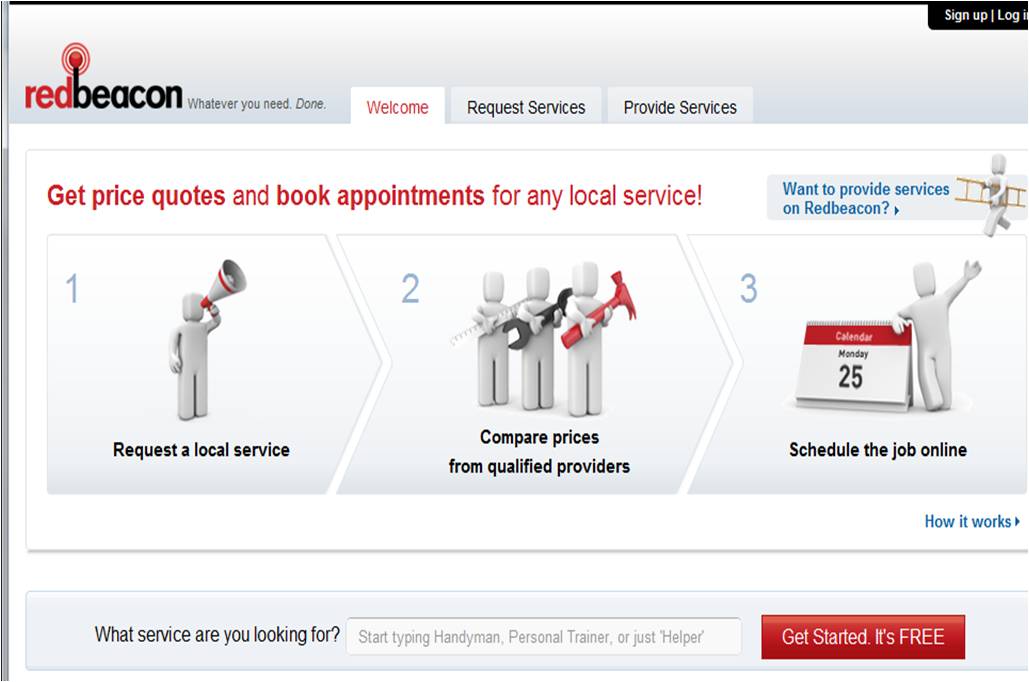
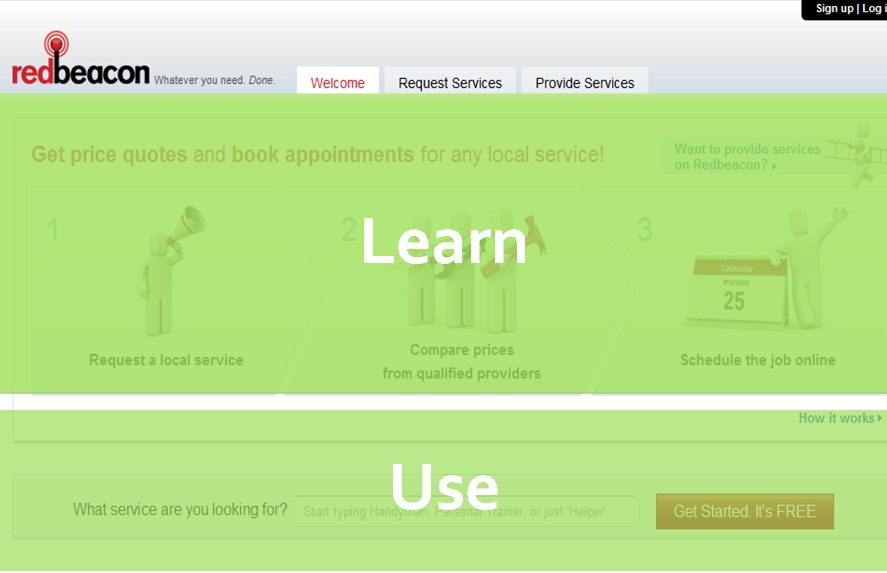
RedBeacon, this year’s TechCrunch50 winner, has recognized that two actions are critical for their users: 1) Learn and 2) Use. They present these two actions, in that order, for all first-time visitors:
ZenDesk
Multiple actions seem particularly prevalent on enterprise sites targeting corporate customers. Trial or Contact actions tend to be present on any first page.
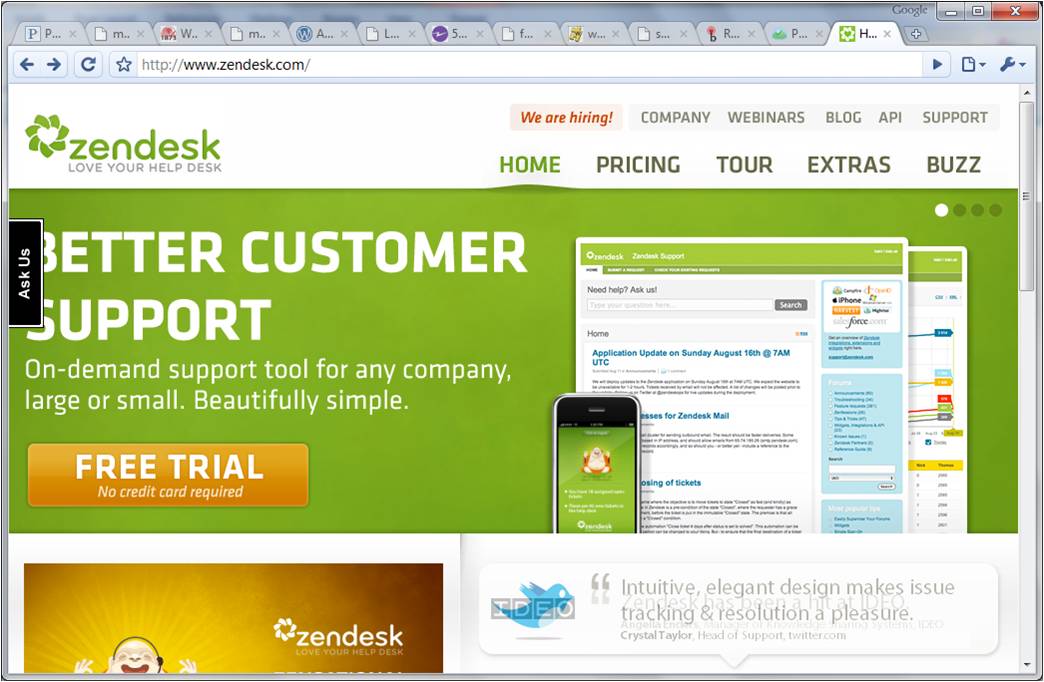
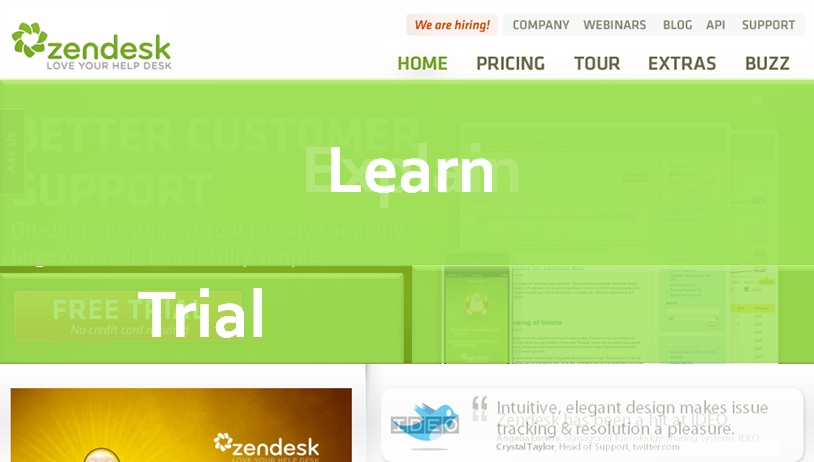
Since many of ZenDesk’s potential customers may be unfamiliar with a SaaS model for helpdesk software, it dedicates considerable screen real estate to Learn, in addition to the Trial that is typical of most enterprise-related sites:
Screen real estate should reflect the importance of the action
RedBeacon
RedBeacon, being a fairly new concept, dedicates roughly 2/3 of their prime screen real estate to Learn, followed by Use for the remaining 1/3.
Dropbox
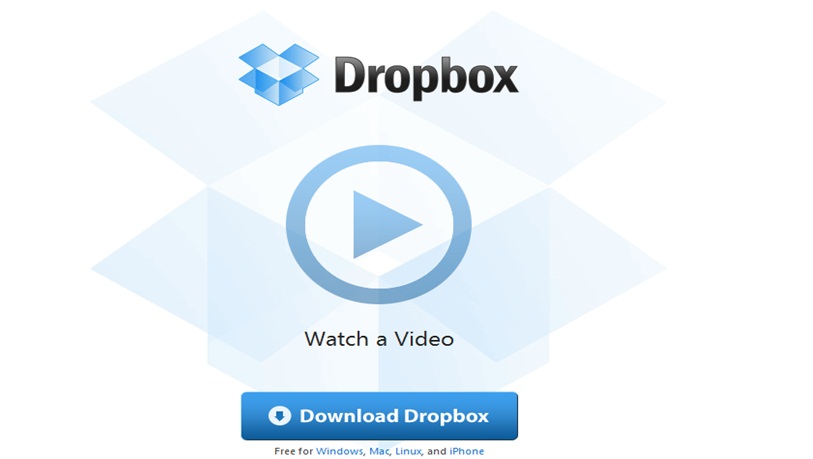
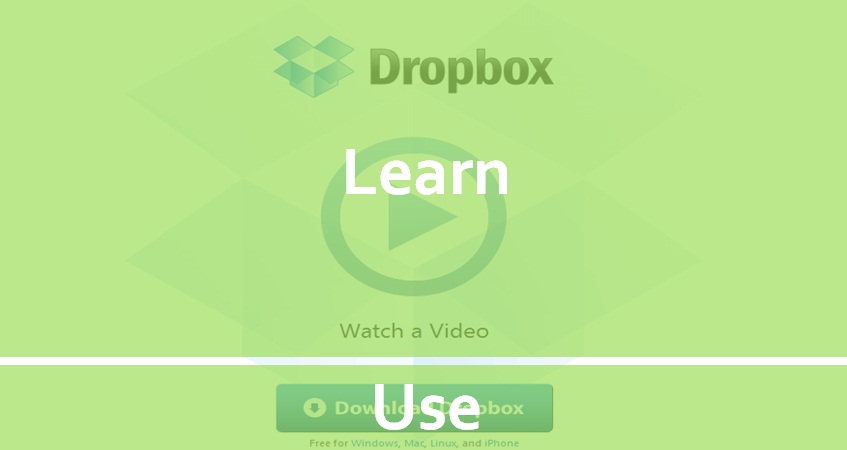
Perhaps the most extreme example I came across was Dropbox. Most visitors wandering onto Dropbox’s site are a) unlikely to fully understand Dropbox’s value proposition and b) hesitant to download and install any out-of-browser software. To deal with these two issues effectively, Dropbox dedicates more than 80% of their prime screen real estate to the Learn action with a fantastic video. The remaining 20% of the screen real estate is dedicated to the Use action.
Order Matters
It’s important to keep in mind that the order in which you present actions matters. For example, though not always the case, most of the time it makes sense for Learn to be presented first, before Trial or Use.
The order may differ across customer segmentations (e.g. Contact may be optimal for one customer segment, while Trial may be optimal for another). For those targeting international users, recognize that the notion of order depends on your user’s cultural perspective. Presenting certain actions from left-to-right might make sense for English-speaking customers, but for Arabic or Hebrew-speaking customers, it likely won’t, since these users read right-to-left.
Combined Takeaways:
Post #1:
- There is a fairly simple taxonomy of user actions: Use, Register, Learn, Guide, Trial, and Contact.
- Getting new users to stick involves two difficult things: a) Knowing which of these actions is “sticky†for your users and b) Incentivizing users to perform those actions.
- This is highly dependent on the nature of your product and who your users are. For example, “Register†would be ineffective for TheSixtyOne when visitors likely have little patience to register for yet another online radio service.
- Don’t think about your web site as a series of pages that visitors see. Think of it as a series of actions you want visitors to take.
Post #2:
- Actions are not mutually exclusive. It often times makes sense to present more than one action on a single page.
- Screen real estate dedicated to a given action should generally reflect the relative importance you assign to that action.
- The order in which actions are presented matters a lot. Make sure you understand the optimal order of actions to get users to stick. The optimal order may change based on your customers’ cultural perspective, or differ across customer segmentations.
- When in doubt, monitor and test. Most of the sites listed above collect and analyze extensive metrics on their user’s behavior. The sites listed above are also likely utilizing some form of an A/B testing framework to methodically increase conversion rates along each step in the funnel.
March 8th, 2010 at 10:30 pm
Chris,
I think this is a stab at landing pages, but I think you need to consider many more dimensions.
First, you need to define what type of user you are looking at. If it is a consumer (not business)who is not familiar with the service, this might apply. However, business visitors could be a lot different. They might be more invested, and they really might just be looking for a phone number.
Also, what channel are they coming in on. Is it DTI, search, email campaigns, banner ads etc? All have different conversion rates and different levels of commitment.
Finally, any landing page post should be supported by numbers. While we all have guesses, only true A/B testing will show what works. For instance, RedBeacon is a great idea, but it’s traffic has dropped (according to compete.com) since TechCrunch 50. So should this really be an example of what works?
I’m glad you are thinking of this now, because I wasn’t when I was in your shoes. You’ll find that the numbers are the only truth in landing pages.
Good luck!
March 8th, 2010 at 10:45 pm
Hi Rylan, I totally agree… it’s highly dependent on who your customer is, in particular, enterprise customers are certainly looking to be contacted (hence my inclusion of the “Contact” action in the taxonomy, see first post).
I think your point about channel is very interesting. I never thought about whether a landing page should differ based on channel–It seems like it should.
I completely agree that it should be supported by numbers. A/B testing and vigilant analysis of conversion rates is the only way to prove a hypoethesis, the rest, including this blog post is conjecture.
-Chris
March 26th, 2010 at 11:17 pm
thanks for the info!